
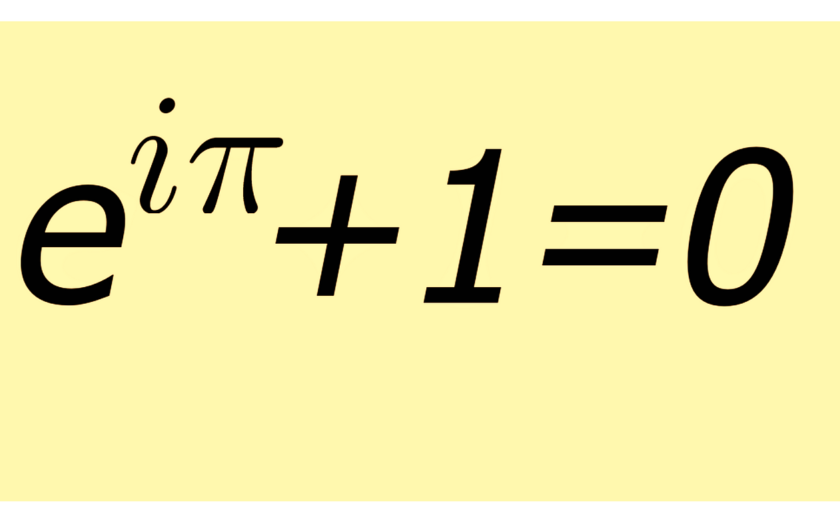
I was introduced to ‘e’ at school. The quintessential natural logarithm or ln as it was called, was supposed to have a base ‘e’ (whatever that meant). Then I ‘met’ it again in calculus when the formula page for differentiation included
Thank God – it is the same. One less thing to remember as we were trying to pile up stuff in memory ‘studying’ for board exams and entrances. I met it again in my M.Tech in AI/ML but I was not curious enough even then – to probe and understand what is was all about, instead trying to finish my assignments and prepare for my exams . Later, when the mayhem had settled and I had the patience to be reflective, I went back to learn some basic maths and boy I found a diamond.
Now, learning has come a long way – from great teachers to wonderful books, YouTube lectures, Audible Great courses and so on. But learning, with an LLM as your guide, can be fun and more importantly it is very liberating. You are not constrained by the teacher’s knowledge (or mood) or by the content’s scope in a YouTube video. You are not going to stop asking the most basic and ridiculous questions, which, you would never have done in school. Also you could take several branches to explore other related stuff to come back and continue from where you left, in your learning journey.
That is how I met ‘e’ again. I was learning basic calculus and hit the same d/dx(e^x) = e^x (rate of change is same as itself), but instead of stopping at that like most school Maths teachers, the LLM nudged me into giving an extra detail. It said “It is the only function in the universe that is its own derivative and so becomes a native language for higher math”. That piqued my interest sufficiently and I went probing deep into ‘e’. I realised that it can feature in Compound Interest (Economics) and equally in the growth of Bacteria (Biology) while also contributing to Radioactivity (Physics) along with funnily, Probability (Maths) as well, other than calculus of course. I will distill some of that here for other curious souls.
Simply put ‘e’ is just a number: 2.7182 (goes on like pi but let’s stop here). What is special about this number between 2 and 3.
Let’s take money for our example, because, well I like the subject personally, but this applies to anything for which the growth depends on the amount of existing stuff.
Imagine you have 100 Rs. In 5 years it can grow another 100%.
1: 100% in one shot – One option for this growth is at exactly on the midnight of the last day of the 5th year, we put 100 more (100% of 100) and make it 200 (Principal of 100 + Interest of 100).
2: Another option is to give yearly interest and allow the interest to earn more income. So the 100% interest for 5 years is given as 20% per year. So at the end of year 1 you get 120 Rs (Principal of 100 Rs + Interest of 20 Rs) and the entire 120 Rs goes to work for you at 20% interest for next year giving you 224 (Principal of 120 Rs + Interest of 24 Rs). Note that the additional 4 Rs was earned from the extra 20 Rs that came as interest in the first year and worked as principal in the 2nd year. Hope you are with me till now. Going on at the end of 5 years you have 249 Rs instead of the 200 you got earlier with Option 1.
3: Naturally the next option is to Split the interest monthly giving 100% divided by 60 months = 1.66% per month. So at the end of first month we have Principal of Rs 100 + Interest of Rs 1.66 = Rs 101.66. This continues every month and you end up with 270 Rs after 5 years.
4: The last option is daily interest which gives you 271.179 Rs (calculate it to cross check)
Now you might think that going even finer like hourly, secondly etc can lead you to higher numbers and may be we can even cross 1000 Rs by the end of 5th year going extremely fine. But you will find that how much ever finer you go you hit a mathematical ceiling at 271.82 Rs and you will not be able to cross it. Curiouser and curiouser!
Check the graph below to see how things grow and how it hits ‘e’ (Note: Daily is hidden for us since it is plotted below blue of ‘e’ both being very close) Also note: Since we started with 100 Rs we get 271.82 Rs. If we had started with unit rupee (that is just one rupee) we would have reached 2.7182 which is exactly our ‘e’)
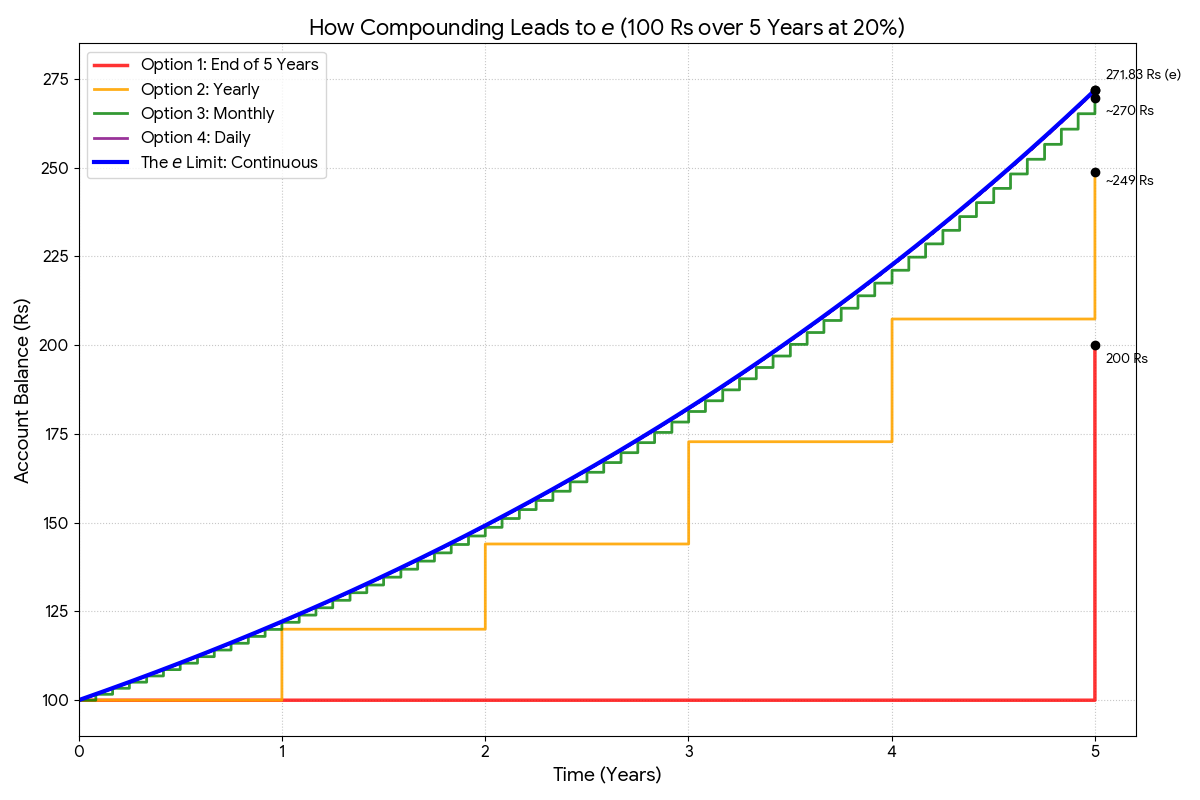
So ‘e’ is nothing but the natural speed limit of a 100% growth. In fact the same analogy applies to say a culture of bacteria growing in a test tube or the population growth in a country or how quickly a virus spreads and many more such natural events. It can even be used to explain the decay (on the inverse side), like cooling down of things (the cooler they are –> the faster they cool and become cooler increasing the cooling and so on) or decay of radioactive stuff.
Isn’t this beautiful but does it explain why d/dx of e^x is e^x. Not quite. And that could be part 2 or hopefully I have kindled some curiosity fire inside you to go figure it out yourself – may be with an LLM by your side.